Napier has a well-established Māori history with Ngāti
Kahungunu being the dominant iwi in the area, and one of the first tribes to
encounter European settlers.
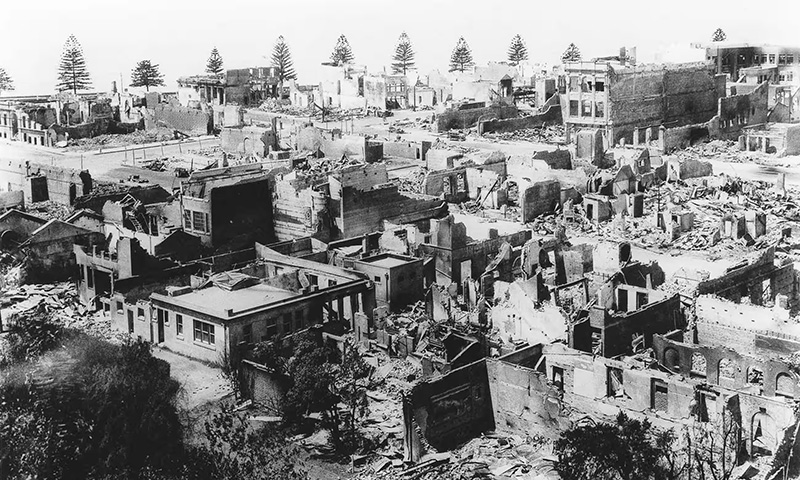
Thoughts soon returned to the rebuild of the Napier CBD.
What resulted was a mix of styles, with Art Deco being the predominant, along
with Spanish Mission, Stripped Classical and Classical Moderne.
Nearly all of the city's new buildings were designed by local architects. A co-operative group called the Associated Architects of Napier was formed to get construction quickly underway. Its members were J. A. Louis Hay, E.A. Williams, C.T. Natusch and sons, and Finch and Westerholme. In the spirit of co-operation fostered by this Association, the architects attempted to relate the appearance of all the new buildings to one another. Most buildings erected following the earthquake were designed in what can very broadly be described as the Art Deco style. This style had been popularised in 1925 at the International Exposition of Modern Decorative and Industrial Arts, held in Paris.
Art Deco was considered to be a very 'modern' style, well suited to the image that Napier wanted to project as a city. For these reasons, Art Deco buildings found favour with both architects and the public. A number of buildings erected after the earthquake were not Art Deco at all, the 'Spanish Mission' style being a popular alternative. They add a Mediterranean flavour to the city well suited to the sunny climate, and they relate well to their Art Deco neighbours.
Following World War II, further industrial development was encouraged in Napier. The city’s progress has been heavily dependent on the success of farming, horticulture, forestry, wine making, processing, and tourist attractions in the surrounding area.
Enhanced by palms and the angular Norfolk Island pines which are its trademark, and surrounded by fertile fruit and grape growing plains, dramatic hills and the shores of the South Pacific, beautiful Napier is the centre of Hawke’s Bay, recently named a World’s Great Wine Capitals.